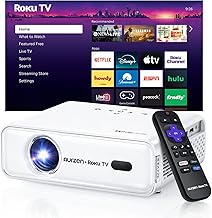
Comparison: projector form factors for ADU cinema conversion
| Form factor | Throw distance needed | Typical brightness | Best for | Watch out for |
|---|---|---|---|---|
| Standard long-throw 4K laser | 10–14 ft | 2,500–3,500 ANSI | ADUs with 14+ ft depth and ceiling mount | Cable runs, ceiling height for mount |
| Short-throw 4K (0.5–0.8 ratio) | 6–9 ft | 2,000–3,000 ANSI | Compact ADUs, shelf mounting | Limited model selection at 4K |
| Ultra-short-throw laser TV | 6–18 in | 2,500–4,000 ANSI | Studio ADUs, no overhead cabling possible | Wall flatness, requires UST ALR screen |
| Portable LED | 4–8 ft | 400–1,200 ISO | Guest house used occasionally | Brightness, fan noise, not for HDR |
| 1080p lamp budget | 10–14 ft | 2,200–3,000 ANSI | Tight budgets, accept bulb replacement | Resolution, lamp life, color drift |
Choosing the best projector for detached ADU backyard guest house cinema conversion comes down to four constraints most buyers underestimate: the short wall-to-wall distance of an ADU, the unpredictable ambient light that bleeds in from sliding doors and skylights, the limited HVAC headroom for heat-dumping lamps, and the noise floor of a small room where you can hear every fan blade. The sweet spot for 2026 is a 0.7–1.2 throw-ratio 4K laser or LED projector pushing 2,000–3,000 ANSI lumens, with quiet (<28 dB) cooling and HDMI 2.1 if a console will live in the guest house. This guide walks through every decision — throw math, screen pairing, ceiling versus shelf mounting, electrical load, and acoustic treatment — so your ADU cinema works the first night and every night after.
Why ADU cinema conversions are different from a normal living room
A detached accessory dwelling unit is usually 400–1,200 square feet with a single main room that has to serve as living, sleeping, and sometimes kitchen space. That has three implications for projector choice that don't apply in a standard media room. First, your throw distance is short — frequently 8 to 12 feet from the back wall to the projection wall — which immediately rules out most long-throw home theater projectors built for 14–20 foot rooms. Second, ADUs almost always have at least one large glazed surface (the back slider, a clerestory, or a skylight required by code for egress and natural light), so a 1,200-lumen "dedicated dark room" projector will look washed out unless you commit to full blackout curtains. Third, the room is small enough that fan noise from a 35 dB projector sitting six feet behind the couch becomes part of the soundtrack.
When shopping for best projector for detached ADU backyard guest house cinema, it pays to compare specs, capacity, and real-world runtime before committing.
The good news: ADUs also have advantages. The ceilings are often 9 to 10 feet (especially in new-build California ADUs designed to maximize volume), the walls are short runs so in-wall HDMI is trivial, and you typically have a brand-new 100–200 amp subpanel with plenty of dedicated circuit headroom for AV gear. The trick is matching a projector to those specific constraints rather than buying whatever was on sale for the family room.
Throw distance: the single most important spec for an ADU
Before you look at a single product page, measure two distances in your ADU: the wall you intend to project onto, and the distance from that wall to where the projector will physically live. If the projector will sit on a shelf behind the seating, your throw distance is roughly the room depth minus a foot or two. If you're ceiling-mounting in the middle of the room, it's the distance from the lens to the screen wall.
For a 100-inch diagonal 16:9 image — a comfortable size in a 12-by-16 ADU — a standard 1.2 throw-ratio projector needs roughly 8.7 feet of clearance. A 1.5 throw ratio needs 10.9 feet. An ultra-short-throw (UST) laser TV sits 6 to 18 inches from the wall and throws upward. UST is the cleanest fit for the smallest ADUs because it eliminates the cable run across the room and removes the projector from your sight lines entirely, but UST units are more expensive and demand a perfectly flat, vertical wall or an ALR (ambient light rejecting) UST-specific screen to look their best. For deeper background on this math, the projector throw distance guide walks through the formulas for every common throw ratio.
Lumens: how much brightness do you actually need?
An ADU is rarely a true "bat cave" home theater. Even at night, you'll have appliance LEDs, a kitchenette under-cabinet light, and ambient bleed from the main house's porch lights through windows. For a 100-inch image with light controlled by curtains, 2,000 ANSI lumens is the practical minimum and 2,500–3,000 ANSI lumens leaves comfortable headroom for HDR highlights. If your ADU has unavoidable daytime use — say it doubles as a home office and your kids want to watch a movie at 3 p.m. — push toward 3,000–3,500 ANSI lumens and pair with a high-gain or ALR screen.
Be careful with manufacturer brightness claims. ISO 21118 (often labeled ANSI lumens) is the only spec worth comparing. "LED lumens" or "light source lumens" can be inflated by a factor of three or more. The projector lumens guide breaks down how to read the marketing copy and what each number really means at the screen.
Light source: laser, LED, or lamp?
Lamp projectors are cheap up front but burn through $150–$250 replacement bulbs every 2,500–4,000 hours and dim noticeably over their lifetime. For a guest house where you can't easily climb up to swap bulbs, and where guests may not know to put the unit in eco mode, lamps are a poor fit.
Laser projectors (laser-phosphor or triple laser) are the right answer for almost every ADU cinema in 2026. They hit full brightness in three seconds, last 20,000–30,000 hours, don't dim meaningfully over time, and produce more saturated color. The downside is price — entry laser units start around $1,500 and good ones run $2,500–$5,000.
LED-only projectors (without a laser component) split the difference: long-lived light source, lower power draw, but typically lower peak brightness. They work well in smaller ADUs (under 80-inch images) with full light control.
Screen choice for an ADU: matte white, ALR, or just paint?
Painting the wall is tempting in an ADU because it removes one piece of furniture from a small room, but the result is usually disappointing — drywall texture creates visible shadows and gain is uneven. A pull-down or fixed-frame screen is a small investment that meaningfully improves the picture.
For a darkened ADU, a 1.0–1.1 gain matte white screen gives the most accurate color and the widest viewing angle. For an ADU that doubles as office or kitchen with ambient light, an ALR screen (ambient light rejecting) preserves contrast by reflecting the projector's on-axis light back while absorbing off-axis room light. ALR screens are throw-specific — you must buy a UST ALR screen for a UST projector and a standard ALR screen for a long-throw unit; mixing them produces a dark blob in the middle of the image. The guide to choosing a projector screen covers gain, viewing cones, and aspect ratios in detail.
Mounting and placement in a small space
You have three options in an ADU: ceiling mount, rear shelf, or front coffee table.
Ceiling mounting is the cleanest because it removes the projector from the floor plan entirely. In an ADU with 9-foot ceilings and a 10-foot throw, a ceiling-mounted 4K projector lives directly above the back of the couch and throws over the seating area. Run the HDMI and power inside the wall during the conversion — trying to hide cables after drywall is in is painful. For step-by-step electrical and bracket guidance see the ceiling mounting walkthrough.
Rear shelf mounting works if you have a built-in or floating shelf at the right height behind the seating. It's the most flexible — you can move the unit — but it puts the fan two feet from your ears.
UST changes the equation: the unit sits on a low credenza directly under the screen wall, so there's no overhead cabling, no fan over your head, and no shadow when someone walks across the room. For studio-style ADUs without a clear back wall, UST is often the only sensible answer.
Audio: the part most ADU builders get wrong
Projector speakers are universally underwhelming, but in an ADU you have a unique problem: you're often sharing a wall with the neighbor's setback or the main house, so an 80 dB action movie at 11 p.m. is not neighborly. A 2.1 soundbar with a wireless sub solves the immediate audio quality issue and lets you keep levels reasonable. For Atmos enthusiasts, the ADU's smaller volume actually makes object-based audio easier — 4 or 6 speakers in a small room produces dense, accurate placement. The soundbar connection guide covers ARC, eARC, and the HDMI handshake quirks that bite first-time installers.
What to look for in the spec sheet
When evaluating any candidate for the best projector for detached ADU backyard guest house cinema build, work through this checklist:
- Native 4K (3840×2160) or pixel-shifted 4K — both look excellent; native is sharper at very large sizes but rarely worth the price premium for ADU-scale 100–120 inch images.
- HDR10 and HLG support — Dolby Vision on projectors is rare and usually a marketing checkbox; HDR10+ tone mapping is what you actually use.
- Throw ratio in the range you measured — not "flexible enough," but actually matching your room.
- Lens shift and keystone — vertical and horizontal lens shift lets you mount off-center without distortion; rely on digital keystone only as a last resort because it costs resolution.
- Input lag under 30 ms at 4K/60 if anyone games — the low-lag 4K gaming guide covers PS5 and Xbox Series X pairings.
- Fan noise under 28 dB in eco mode — critical in a small room.
- Smart TV onboard — nice for guests, but verify Netflix is supported natively or plan to add a Fire TV or Apple TV.
Electrical and HVAC considerations during the build
If you're still mid-conversion on the ADU, rough in two things before drywall closes: a dedicated 15-amp circuit terminating in a ceiling box where the projector will mount, and a low-voltage conduit from that box to the equipment shelf or wall plate where your sources will live. Pull a fiber HDMI cable (the optical kind, rated for 4K/60 4:4:4) plus a Cat 6 line for future control. Most ADU cinema regrets trace back to running a single 15-foot HDMI through a vent because no one planned the cable path.
Projectors dump 150–300 watts of heat into the room while running. In a small, well-insulated ADU, that's enough to raise the temperature 3–5 degrees over a two-hour movie. Size the mini-split or HVAC accordingly, and don't put the projector directly under a supply register where it will get dusted constantly.
Budget framing for an ADU cinema
For a complete ADU cinema conversion in 2026, expect to spend $2,500–$6,000 on AV depending on ambitions: $1,200–$3,500 projector, $300–$1,200 screen, $400–$1,500 audio, $100–$300 mount and cabling, $200–$500 streaming and control. The home theater projector budget guide breaks down what you actually get at each price tier.
Frequently Asked Questions
What size projector screen fits a 12-by-16-foot ADU living area?
A 100-inch diagonal 16:9 screen is the sweet spot for that footprint. It gives roughly a 35-degree viewing angle from a couch 10 feet back, which matches SMPTE recommendations for cinema immersion without forcing eye movement. A 120-inch screen works only if you can seat people 12+ feet back; closer than that and you'll see pixel structure and lose focus on the edges.
Can I use a portable projector for an occasional-use guest house cinema?
If the ADU genuinely is used only a handful of nights per year, a portable 1080p LED unit can work for casual streaming. You'll trade brightness, color accuracy, and HDR for portability and a sub-$700 price. For anything resembling regular movie nights, the brightness ceiling becomes frustrating quickly.
Do I need an ALR screen for a detached ADU?
It depends on light control. If you'll install blackout curtains and watch only at night, a 1.1-gain matte white screen produces the best image. If the ADU has skylights you can't cover, or you want daytime viewing, an ALR screen matched to your projector's throw is worth the $400–$1,000 premium.
Is UST or long-throw better for converting a small ADU?
UST wins when floor plan space is tight, when you can't run ceiling cables, or when the ADU doubles as a guest bedroom and you don't want hardware overhead. Long-throw wins on price-per-lumen, gives you more model choice, and isolates the fan noise behind the seating. For most 400–600 square foot ADUs, UST ends up cleaner.
How loud are projectors and will guests be able to sleep nearby?
Modern laser projectors run 24–30 dB in eco mode, which is quieter than a refrigerator. Lamp-based projectors in high brightness mode hit 32–38 dB and are clearly audible. If the ADU is studio-format and someone will sleep in the same room, pick a laser unit rated under 26 dB or commit to powering it off at bedtime.
What ceiling height do I need to mount a projector in an ADU?
For ceiling mounting a standard throw projector with a 100-inch screen, you want at least 8.5 feet of ceiling clearance so the lens sits above viewers' heads and above the top of the screen. Most newer ADUs ship with 9 or 10 foot ceilings, which is plenty. For 8-foot ceilings, consider a UST or a low-profile shelf mount instead.
Can I run the projector and AV gear off the ADU's existing electrical panel?
Yes — a projector pulls 200–350 watts at most, well under a single 15-amp circuit. The issue isn't capacity but isolation: put AV on its own dedicated circuit so the mini-split compressor cycling doesn't dump electrical noise into your audio chain. A licensed electrician can add a dedicated circuit in an existing ADU panel in under an hour.
Should I get a 4K projector or is 1080p enough for an ADU?
At a 100-inch screen viewed from 10 feet, 4K is visibly sharper than 1080p — you can resolve detail in faces, textures, and text overlays that 1080p smears. The price gap between 1080p and pixel-shifted 4K has narrowed to roughly $400 in 2026, so 4K is the default recommendation for any permanent ADU cinema build.
Putting it together
The best projector for detached ADU backyard guest house cinema conversion is the one whose throw ratio, brightness, and noise floor match your specific room — not the brightest, most expensive, or most reviewed unit on the market. Measure your throw distance first, decide on UST versus long-throw second, set a screen budget third, and only then start comparing models. Rough in cabling and a dedicated circuit before drywall, plan for HVAC heat load, and pair the projector with audio that respects your neighbors. Done in that order, an ADU cinema rivals a dedicated theater room in a much larger house at a fraction of the construction cost.
Key Takeaways
- Choosing the right best projector for detached ADU backyard guest house cinema means matching the key features to your specific needs and budget
- Read real customer reviews and check the return policy before you commit
- Also covers: adu home theater projector
- Also covers: backyard guest house projector setup
- Also covers: granny flat projector cinema
- Compare value across models — the priciest option is not always the best fit