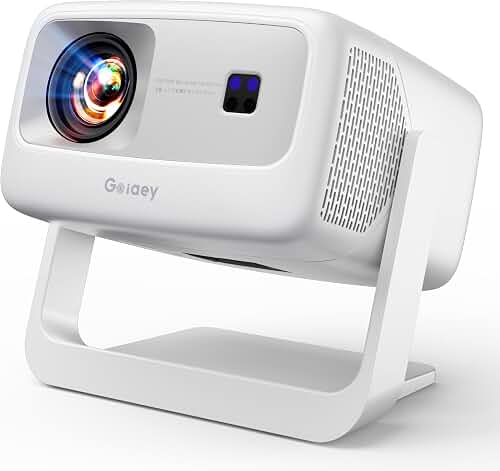
The best portable projector for RV camping 12v power needs three things working together: a battery that survives a full movie on a single charge, a 12V DC input (or USB-C PD input that can be fed from a 12V-to-USB-C adapter), and enough brightness to cut through ambient light from your awning lantern or a campfire. In 2026 the sweet spot is a 1080p or 4K LED/laser unit between 400 and 800 ANSI lumens, weighing under 5 lbs, that draws 30-65 watts so your house battery doesn't drain before the credits roll. This guide walks through the wattage math, the cabling, the screen options, and the trade-offs between brightness, runtime, and pack size so you can pick a model that genuinely works for off-grid movie nights.
Why RV camping projectors are a different animal
Living-room projectors assume you have unlimited 120V AC, a dark room, and a fixed screen. None of those are guaranteed in an RV. Your power comes from a 12V house battery (often a 100Ah lithium or AGM), your viewing surface might be the side of the rig or a pull-down sheet, and ambient brightness changes from pitch-black boondocking to a moonlit beach to a neighbor's porch light. The best portable projector for RV camping 12v setups have to negotiate all three of those variables without forcing you to fire up a generator or pull out a 2000W inverter just to watch a movie.
When shopping for best portable projector for rv camping 12v, it pays to compare specs, capacity, and real-world runtime before committing.
The good news is that the portable-projector category exploded between 2022 and 2026. What used to be a 200-lumen toy bright enough only for a kid's bedroom is now a 400-800 ANSI lumen LED or laser unit with onboard Android TV, autofocus, auto-keystone, and a battery that runs 2-4 hours. The bad news is that marketing lumens ("1500 lumens!") on Amazon still bear little resemblance to honest ANSI ratings. We'll sort that out below.
How 12V power actually works in an RV
An RV "12V system" is nominal — house batteries actually float between 11.8V (nearly dead) and 14.4V (charging from solar or the alternator). That matters because cheap projector car adapters are often regulated for exactly 12.0V and brown out the moment your solar controller kicks in. There are three sane ways to power a projector off your house battery:
- USB-C Power Delivery (PD): Easiest path. A 12V-to-USB-C PD adapter (look for 65W or 100W PD3.0 output) plugs into a standard cigarette lighter / 12V socket and outputs the 20V the projector needs. Most modern portables — Anker Nebula, XGIMI Halo+, Samsung Freestyle Gen 2 — accept USB-C PD power input.
- Direct DC barrel jack: Some projectors ship with or sell a dedicated 12V car cable. Check polarity and voltage carefully. A projector spec'd for 19V will not run on raw 12V even though the plug fits.
- Pure-sine inverter: A 300W pure-sine inverter wired to your house battery will run any 120V projector. You lose about 10-15% to inverter efficiency, but you keep every feature including HDMI-ARC and the full lamp brightness that battery mode often throttles.
Quick math on runtime: if your projector draws 50W and you have a 100Ah lithium battery at 12V, that's 1200Wh of capacity. Even leaving 20% reserve, you have ~960 usable watt-hours, which is roughly 19 hours of projector run-time before you've touched the rest of your loads. A 50Ah AGM at 50% depth-of-discharge gives you ~6 hours. That's plenty for one or two movie nights between solar recharges.
The specs that actually matter for RV use
ANSI lumens (not "LED lumens" or "light source lumens")
For an RV scenario where you're projecting outside on an awning screen after dark, 300-500 ANSI lumens is genuinely watchable on a 60-80 inch image. Below 200 ANSI lumens you need full darkness and a small image. Above 700 ANSI lumens you start to handle dusk viewing and larger 100+ inch images. See our projector lumens guide for a deeper breakdown of how to translate marketing numbers into real-world brightness.
Battery life and charge time
A 2-hour battery covers most movies but not an extended-edition Lord of the Rings night. Look for 2.5+ hours in movie mode at moderate brightness. Charge time matters too — some portables take 4 hours to refill, which is fine overnight on shore power but painful if you arrive at camp with a dead unit.
Native resolution
1080p is the practical floor for 2026. 4K is overkill for most outdoor RV use because campsite ambient conditions and a wrinkly bedsheet "screen" will obliterate any pixel-level detail. Spend the resolution budget on brightness and battery instead.
Weight, size, and ruggedness
RV storage is precious. A projector that's bigger than a loaf of bread is going to live in a cabinet you don't open often. Aim for under 4 lbs and a footprint that fits in an overhead bin. IPX-rated water resistance is a bonus — even "IPX2" gives you forgiveness against dew and a sudden sprinkle.
Built-in streaming and audio
Out at a remote campsite, casting from your phone via hotspot is often the only way to get content. A projector with native Netflix/Disney+/YouTube apps and decent built-in speakers (8W+ stereo) means you don't have to pack a Fire TV stick and a Bluetooth speaker as separate accessories. That said, native Netflix on Android TV portables is often sideloaded and breaks with updates — check the latest user reports before buying.
What about throw distance in a tight RV setup?
You're rarely going to get a 12-foot throw outside an RV. Most portables have a throw ratio around 1.2:1, meaning a 100-inch image needs about 8.7 feet of distance. If you're projecting onto the side of your rig with the projector on a picnic table 6 feet away, you'll get about a 70-inch image. Short-throw portables (0.8:1 ratio) let you get the same image from 5 feet, which is gold for tight campsites. Our projector throw distance guide has the formulas and a calculator.
Categories of portable projector worth considering
Compact LED portables (under 3 lbs, 200-400 ANSI lumens)
These are the truly grab-and-go units. Think Anker Nebula Capsule line, XGIMI MoGo 3, Samsung Freestyle. They're soda-can to lunchbox sized, run 2-3 hours on internal battery, and project a respectable 60-80 inch image in true darkness. Trade-off: too dim for dusk or any ambient light. If you only watch after the campfire dies and the kids are asleep, these are perfect.
Mid-size LED/laser portables (3-5 lbs, 400-800 ANSI lumens)
This is the RV sweet spot for 2026. Models like the XGIMI Halo+, Anker Nebula Mars 3, and various LG CineBeam portables hit 400-700 ANSI lumens, run 2-3 hours on battery, and can throw a usable 100-inch image. They're bulkier — usually with a built-in handle — but still fit in an RV cabinet. Most accept USB-C PD power for easy 12V adaptation.
Rugged outdoor-focused portables
Newer entrants like the Anker Nebula Mars 3 are explicitly designed for camping, with IPX rating, integrated handle, and longer battery life (4+ hours). They cost more but solve the "is this dew going to fry it" question. For deeper coverage of outdoor-optimized models, see our roundup of the best outdoor projectors for backyard movie nights — many of the same units excel at campsites.
Convertible home portables
Some "portable" projectors don't have batteries but are still light enough (5-7 lbs) to move between living room and RV if you run an inverter. They typically offer better picture quality and brightness for the same money than battery models. If you have a 300W+ inverter installed, this category is worth a look — you get genuine home-theater quality at camp without paying the battery premium.
A practical RV projector kit
Beyond the projector itself, here's what makes the best portable projector for RV camping 12v setup actually work in the field:
- 12V-to-USB-C PD adapter (65W or 100W): $25-40. Plugs into your cigarette lighter, outputs PD3.0 over USB-C. Powers most modern portables indefinitely.
- Portable screen or blackout fabric: A 100-inch inflatable or pull-up screen runs $80-150. Cheaper option: a king-size blackout curtain panel and four clamps. Projecting on a white RV side wall works too, but seams and dirt show.
- Bluetooth speaker: Even projectors with decent onboard speakers struggle outside where there's no room reflection. A small JBL or Soundcore unit dramatically improves intelligibility.
- HDMI-input streaming stick: If you don't trust the onboard Android TV, a Fire TV Stick or Roku Express ($30) plus an offline-download library on your phone keeps you watching when you're miles from LTE.
- A small soft case: RV cabinets bang around. A neoprene sleeve or padded camera bag protects the lens.
If you're shopping the broader portable market, our roundup of the best portable mini projectors for home theater covers indoor-focused models too, several of which double well as RV travelers.
Common mistakes RVers make buying their first projector
Believing the lumen marketing: A projector listed as "9000 lumens" on a $200 Amazon page is almost certainly 150-300 ANSI lumens. Filter your search for ANSI-rated specs or skip unrated units entirely.
Forgetting about sound: Outdoor environments swallow audio. Onboard 3W speakers are inaudible 10 feet away. Budget for Bluetooth audio.
Ignoring battery degradation: Lithium-ion in projectors degrades faster than in laptops because of heat. After two years of regular use, expect 70-80% of original runtime.
Buying for the wrong viewing distance: If your campsite layout puts you 5 feet from the screen, a long-throw model gives you a postage-stamp image. Measure your typical setup before buying.
Not testing the 12V path before leaving: Your shiny new USB-C PD adapter may not negotiate the right voltage with your specific projector. Always test the full power chain at home before relying on it at camp.
Frequently Asked Questions
Can I really run a projector off my RV's cigarette lighter outlet?
Yes, with a caveat. Most cigarette-lighter sockets are fused at 10-15 amps, which is 120-180 watts of headroom — more than enough for a 50W projector. Use a quality 12V-to-USB-C PD adapter rated for at least 65W output, and avoid running other high-draw devices (microwave, coffee maker) on the same circuit. Check that the socket is wired to the house battery, not the chassis battery, so you're not draining your starter battery.
How many lumens do I need for outdoor RV projection?
In full darkness on a proper screen, 300-400 ANSI lumens delivers a watchable 80-inch image. For dusk viewing or larger 100+ inch images, you'll want 500-800 ANSI lumens. Above 1000 ANSI lumens you're into models that almost never have batteries, so you'd be on inverter or shore power. For a deeper dive, the how many lumens home theater projector guide breaks down brightness needs by viewing condition.
What's the difference between LED and laser portable projectors for camping?
LED light engines last 20,000-30,000 hours, run cooler, and are cheaper. Laser engines (or laser-LED hybrids) hit higher brightness in the same form factor, start up instantly, and hold color accuracy better, but cost more and run hotter. For RV use, LED is usually the better trade — lower power draw, less fan noise at night, and adequate brightness for the typical 60-100 inch image.
Will a portable projector handle dew, humidity, or a sudden rain shower at camp?
Most aren't rated for it. The Anker Nebula Mars 3 and a handful of true outdoor models have IPX2-IPX3 ratings that handle splashes and light rain. Everything else should come back inside before dew sets in. Store the projector in a sealed bag with silica desiccant overnight if you camp in humid environments — internal condensation can fog the optics permanently.
Do I need a screen, or can I project onto my RV's wall?
You can absolutely project onto the side of a light-colored RV, and many people do. The image will have seams, dirt shadows, and uneven reflectance, but it works. A dedicated screen — even a $40 fold-up — dramatically improves contrast and color. Blackout fabric stapled to a PVC frame is the cheap DIY answer. For deep coverage of screen choices, see how to choose a projector screen.
Can I stream Netflix and Disney+ at a remote campsite with no Wi-Fi?
Only if you download content ahead of time. Most streaming services let you download to a phone or tablet, then you can mirror or cast to the projector via HDMI or Miracast. Your phone hotspot can stream live if you have strong LTE/5G, but data caps and battery drain make pre-downloading a better strategy for boondocking.
What's a realistic budget for a good RV-friendly portable projector in 2026?
The genuinely-usable range starts around $400 and tops out near $1000 for premium models like the XGIMI Halo+ or Anker Nebula Mars 3. Under $300 you're getting Amazon-special units with inflated lumen claims, no real battery management, and questionable longevity. Over $1000 you're paying for features (4K, laser) that arguably don't move the needle in outdoor RV conditions.
Key Takeaways
- Choosing the right best portable projector for rv camping 12v means matching the key features to your specific needs and budget
- Read real customer reviews and check the return policy before you commit
- Also covers: 12v dc projector for rv travel
- Also covers: battery powered projector rv road trip
- Also covers: projector for camper van movie night
- Compare value across models — the priciest option is not always the best fit