Picking the best projector for rec room with pool table underneath comes down to three constraints most buyers overlook: the pool-table pendant light blasting ambient lumens onto your image, the need to ceiling-mount high enough that cue tips never tap glass, and a throw distance that clears the table without forcing the screen into an awkward corner. For a typical 8 to 9 foot ceiling rec room with a 7 or 8 foot pool table, you want a 1080p or 4K projector delivering at least 2,500 ANSI lumens, a throw ratio under 1.3, and vertical lens shift or strong keystone correction so the image lands cleanly on a screen mounted above eye level.
This guide walks through exactly how to choose that projector in 2026, why the pool table changes the math, and how to set up a system that lets you rack a game and stream a movie in the same room without compromise.
Finding the right best projector for rec room with pool table comes down to matching the features to how you will actually use it.
Why a Pool Table Rec Room Is a Unique Projector Challenge
Most home theater advice assumes a dedicated, light-controlled room with seating arranged in front of a screen. A rec room with a pool table breaks every one of those assumptions. The table sits in the middle of the floor, the pendant lamp above it pumps out 300 to 1,000 lumens of warm light at exactly the height where it will wash out a projected image, and your viewing seating (couches, bar stools, lounge chairs) is usually pushed to the perimeter rather than centered.
The good news: with the right projector and a smart mounting plan, you can have both a tournament-grade billiards setup and a legitimate big-screen movie experience in the same footprint. The bad news: a $400 portable projector you'd love in a dark bedroom will look like a faded poster in this environment. Brightness, throw geometry, and mount height are not negotiable.
The Five Specs That Actually Matter for a Pool Table Rec Room
1. Brightness: 2,500 ANSI Lumens Minimum, 3,000+ Preferred
A pool table pendant is essentially a giant softbox aimed at the felt. Even when you dim it, the bounce light off the green or blue felt scatters across the room. A projector rated for 1,500 lumens that looks gorgeous in a basement cave will look gray and washed out here. Aim for 2,500 ANSI lumens as a floor, and ideally 3,000+ if you want to leave the pool lamp on dim while watching sports. LED and laser light sources are particularly useful because they hold their brightness for 20,000+ hours and dim more gracefully than UHP bulbs. Our lumens guide walks through the math in more detail.
2. Throw Ratio: Short Enough to Clear the Table, Long Enough to Be Practical
A standard 8-foot pool table sits roughly 5 feet from each end of a 16-by-22 foot rec room. If you ceiling-mount a long-throw projector at the back of the room, you may be shooting from 18 feet to fill a 120-inch screen. That works fine if you have a 1.3 to 1.5 throw ratio projector and your seating is in front of the table. But if your couch is at the back wall and the table is between you and the screen, you need to either short-throw the projector from above the seating, or use a ceiling mount placed in front of the table aimed back toward the screen wall. Read our throw distance guide before you commit to a mounting position.
3. Mount Clearance: Cues Are Longer Than You Think
A standard pool cue is 57 to 58 inches long. When a player breaks, the butt end can swing back 4 to 5 feet from the rail. If your projector hangs below ceiling on a drop mount and sits within that swing arc, you will eventually hear a $1,200 crunch. Either ceiling-mount flush, place the projector well outside the table footprint (front shelf, rear shelf, or in a soffit), or use a recessed mount. Our ceiling mount guide covers safe drop heights and stud placement.
4. Lens Shift and Keystone: You Won't Get a Centered Mount
Because of the table, you almost never get to put the projector at the geometric center of the room. The mount ends up offset forward, backward, or sideways from ideal. Vertical lens shift (a physical optical adjustment) is far better than digital keystone for image quality, but a projector with strong four-corner keystone correction will at least keep things square when lens shift isn't an option. Avoid models with no keystone whatsoever for this use case.
5. Input Lag and Refresh: If You Game on the Big Screen
Rec rooms are also game rooms. If a PS5 or Xbox Series X is going to share the projector, look for under 20ms input lag at 1080p/60Hz, and ideally 4K/120Hz support with low input lag mode. Many home theater projectors that look great for movies have 50ms+ lag that makes shooters and fighters feel sluggish.
Mounting Strategies for a Pool Table Room
Strategy A: Front Mount (Projector in Front of the Table)
The projector hangs from the ceiling between the table and the screen wall, firing back toward the screen at a short throw ratio (under 1.0). This keeps the projector well out of cue-swing range and minimizes the chance of someone walking through the beam. It requires a true short-throw projector and a screen mounted high on the wall so the image clears the table. Best for rooms where the seating is at the back wall opposite the screen.
Strategy B: Rear Mount (Projector Behind the Table)
The projector hangs from the ceiling at the back of the room, firing forward over the table. This is the classic home theater layout and works with most standard throw projectors. The risk is the beam passing directly over the table at head height, meaning a tall player or a raised cue can briefly cast a shadow on the screen. Mount as high as possible and use a long-throw or standard-throw projector.
Strategy C: Side Wall or Soffit Mount
In rooms with structural soffits or a side bar area, a projector tucked into the soffit firing diagonally across to a screen on the long wall can completely sidestep the pool table problem. This demands aggressive lens shift or keystone correction and careful screen alignment, but it's often the cleanest solution in a finished basement layout. If your rec room is in a basement with low ceilings, also see our low-ceiling basement projector guide.
Screen Choice: Higher and Brighter Than Normal
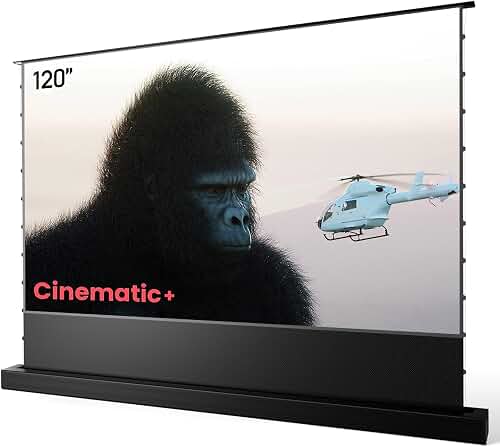
For a pool-table rec room, mount the screen 24 to 36 inches above the table rail so it remains visible from couch seating without the table obstructing the bottom of the image. A 100 to 120 inch diagonal works well in most 16 to 24 foot rooms. Use an ambient light rejecting (ALR) screen if the pool pendant will be on during viewing, or a high-gain matte white screen (1.1 to 1.3 gain) if you're willing to dim the pendant for movies. A motorized drop-down screen lets you retract it completely when the room is in pool-only mode, which protects the screen surface from accidental cue contact.
Light Source: Why Laser Wins in Mixed-Use Rooms
Lamp projectors are cheap upfront but the bulb dims noticeably after 1,500 hours, which is brutal in a bright room where you needed every lumen to begin with. Laser projectors hold 90%+ brightness through 20,000 hours, turn on instantly (no warmup), and handle the frequent on-off cycles of a rec room beautifully. LED projectors split the difference: long life, instant on, but typically lower peak brightness. For a pool table room, the extra $500 to $1,000 for a laser model usually pays back in image quality and longevity.
Audio: Pool Balls Are Loud
The crack of a break is roughly 95 dB at the table. Built-in projector speakers will lose every battle against a live game in progress. Plan for a soundbar with separate subwoofer, or a 5.1 system with the surrounds mounted high enough that they don't interfere with cue movement around the table. Wireless rear speakers are particularly useful here because there's no cable run across the floor for players to trip on.
Setup Tips Specific to Pool Table Rooms
- Mount the projector before you finalize the screen position. The mount has to work around the table; the screen can be moved.
- Test the beam path with the table in place. Stand at every pocket and mime a break to make sure no cue extension reaches the projector or the beam path at face level.
- Use the pool pendant on a dimmer. A 0 to 100% dimmer on the table light lets you balance gameplay visibility against image contrast.
- Run HDMI through the ceiling, not along the baseboard. Cue butts and floor cables do not coexist.
- Calibrate brightness for the room's typical mode. If you mostly watch with the pool lamp dimmed to 30%, calibrate at that level rather than full dark.
Budget Tiers for 2026
Under $1,000: focus on 1080p models with 3,000+ lumens and good keystone. Expect compromises on contrast and color accuracy. Suitable for casual sports and gaming, marginal for cinematic movie nights. Our under-$1000 projector roundup covers current options.
$1,000 to $2,500: the sweet spot. True 4K or high-quality pixel-shifted 4K, 2,500+ ANSI lumens, laser or LED light source, low input lag for gaming. This tier delivers a serious image even with the pool lamp on dim.
$2,500 and up: premium laser projectors with 3,500+ lumens, full lens shift, and excellent HDR. Worth it if the rec room is also your primary viewing space.
Frequently Asked Questions
How high should I mount a projector above a pool table?
Mount the projector flush to the ceiling (or in a recessed cavity) at minimum 8 feet above the floor. The danger zone for cue strikes is roughly 6 to 7.5 feet above the floor on the break. A flush ceiling mount in an 8-foot basement keeps the housing safely above any cue swing, while a drop mount in a 9-foot room should not extend below 8 feet 4 inches.
Can I use a short throw projector over a pool table?
Yes, and it's often the best solution. A short throw projector (0.5 to 1.0 throw ratio) mounted between the pool table and the screen wall keeps the entire light path well clear of the table, eliminates shadow risk from raised cues, and lets you put the screen on the wall most rec rooms already use for a TV. The trade-off is that short throw projectors typically cost more for equivalent brightness.
Will the pool table light ruin my projector image?
It will hurt contrast significantly if left at full brightness. Solutions: install a dimmer on the pendant, choose an ALR screen designed to reject overhead light, pick a projector with 3,000+ ANSI lumens, and angle the pendant shade so light spills onto the felt rather than the screen wall. Most rec room owners run the pool lamp at 20-40% during movies.
What screen size works best in a rec room with a pool table?
A 100 to 120 inch diagonal is the sweet spot. Smaller than 100 inches gets dwarfed by the room and looks weak from couches pushed to the back wall. Larger than 120 inches usually forces the screen edges into corners or down behind the pool table. Confirm sight lines from every seat before ordering.
Do I need a 4K projector for a rec room or is 1080p fine?
For mixed-use rooms with the pool lamp partially on, 1080p often looks just as good as 4K because ambient light degrades fine detail anyway. Spend the 4K premium on better brightness and contrast instead, unless you have proper light control and a 120+ inch screen viewed from under 12 feet.
How do I keep cues from hitting a ceiling-mounted projector?
Three rules: mount flush rather than on a drop pole, position the projector outside the rectangle formed by extending each rail 3 feet outward, and use a recessed mount or in-ceiling housing if the projector must sit directly over the table area. A flush mount in a soffit is the safest option in low ceilings.
Is a laser projector worth it for a rec room?
Yes, for most buyers. Laser projectors keep their brightness through 20,000+ hours, turn on instantly for quick game-night viewing, and handle the frequent on-off cycling of a casual room without burning through bulbs. The $500 to $1,000 premium over a comparable lamp model typically pays for itself in three to five years and delivers better image consistency the whole time.
Key Takeaways
- Choosing the right best projector for rec room with pool table means matching the key features to your specific needs and budget
- Read real customer reviews and check the return policy before you commit
- Also covers: projector clearance over pool table
- Also covers: mounting projector above billiards table
- Also covers: rec room projector pool table setup
- Compare value across models — the priciest option is not always the best fit