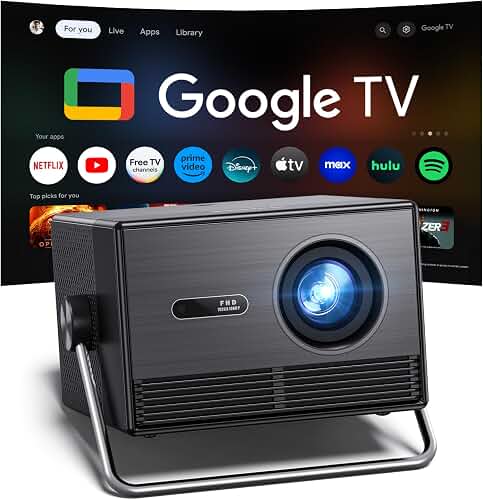
The best projector for sunroom with skylights for daytime Bible study use needs at least 3,500 ANSI lumens (or 4,000+ for true overhead-light defiance), a high-contrast laser or LED light source, and a matte ALR (ambient light rejecting) screen to fight the diffuse skylight glare hitting your image from above. Sunrooms are the single hardest residential environment to project in because skylights pour light from the worst possible angle: straight down onto your screen surface. For reading scripture passages clearly, displaying study notes, and showing video teachings during morning or afternoon sessions, you cannot rely on a standard 2,000-lumen home theater projector. You need a high-output laser or LED model paired with the right screen technology and a few clever room tweaks that we will walk through below.
This guide is written specifically for ministry leaders, small group hosts, and Bible study coordinators who want a permanent or semi-permanent setup in a sunroom space. We will cover lumen requirements, screen pairings, contrast considerations, throw distance for typical sunrooms, and the workflow tweaks that make daytime scripture display actually readable. Because skylights vary so widely (north-facing frosted vs. south-facing clear, single pane vs. tinted), the right projector for your room depends on factors we will help you measure honestly before you spend a dollar.
When shopping for best projector for sunroom with skylights, it pays to compare specs, capacity, and real-world runtime before committing.
Why Sunrooms with Skylights Are the Toughest Projection Environment
A traditional living room has light coming from the sides through windows. You can close blinds, hang curtains, or angle your screen away from the worst offenders. A sunroom with skylights has light pouring down from above, which means it hits the top of your screen at an angle no curtain can block. That overhead light washes out your image more aggressively than any side window because it lands on the screen with nothing to absorb it before reaching the reflective surface.
For Bible study specifically, you are usually displaying text-heavy content: passages from Scripture, sermon outlines, discussion questions, or pre-recorded teaching videos with subtitles or lower-thirds. Text needs higher contrast than movies do. A washed-out movie image is annoying. A washed-out scripture passage is unreadable, and that kills the entire purpose of having a projector in the room.
Lumen Requirements for a Sunroom with Skylights
For typical home theater use in a darkened room, 2,000 to 2,500 ANSI lumens is plenty. For a sunroom during daytime use, you need to roughly double that figure. Here is a practical breakdown:
- 2,500-3,000 ANSI lumens: Workable only with heavy skylight tinting, a top-tier ALR screen, and morning-only sessions before peak sun.
- 3,500-4,000 ANSI lumens: The realistic minimum for usable daytime image with standard skylights and a quality matte ALR screen.
- 4,000+ ANSI lumens: Comfortable readability throughout the day, including high-sun hours, with most screen types.
Be very careful with manufacturer lumen claims. Many consumer projectors advertise "LED lumens" or "light source lumens," which can be two to three times higher than the actual ANSI measurement. Always look for ANSI lumens or ISO 21118 ratings. Our projector lumens guide explains how to decode marketing numbers, and this companion piece walks through real-world brightness needs by room type.
The Screen Matters as Much as the Projector
You can buy the brightest projector on the market and still get a washed-out image in a sunroom if you point it at a white wall or a basic white screen. The screen is half the equation. For sunrooms with skylights, you want one of these two screen technologies:
Ceiling Light Rejecting (CLR) Screens
Designed specifically for ultra-short-throw projectors, CLR screens use a serrated or sawtooth optical layer that absorbs light coming from above (skylights, ceiling fixtures) while reflecting light coming from below (your UST projector on a credenza). For sunroom skylight conditions, a CLR screen paired with a UST projector is arguably the ideal pairing.
Standard ALR Screens for Long-Throw
If you are using a traditional long-throw projector mounted to the ceiling or shelved behind your seating area, you need an angular-reflective ALR screen. These reject ambient light from off-axis angles while preserving on-axis brightness. They work, but not as dramatically as CLR screens do against overhead light. Our screen buying guide walks through gain, viewing angle, and material choices in detail.
Long-Throw vs. Ultra-Short-Throw for a Sunroom
Sunrooms tend to have unusual layouts: angled glass walls, partial knee walls, wicker furniture that does not move easily, and a desire to keep the floor space flexible. Ultra-short-throw (UST) projectors solve a lot of these problems because they sit on a piece of furniture two to ten inches from the wall and throw a 100" image upward. There is no ceiling mount, no long HDMI run across the room, and no chairs blocking the beam.
For Bible study in a sunroom, we recommend UST as the default unless you have a specific reason to go long-throw (very large image sizes over 130", or a budget under $1,500). Read our throw distance guide to understand how the math works for your specific room dimensions, and our ceiling mount guide if a long-throw is your only option.
What to Look for in a Sunroom Bible Study Projector
1. Laser Light Source (Not Lamp)
Lamp projectors lose brightness over time and the bulbs cost $200-300 to replace every 2,000-4,000 hours. Laser projectors hold their brightness for 20,000-30,000 hours and never need a bulb change. For a permanent installation that will run multiple sessions per week, laser is non-negotiable.
2. High Native Contrast
Contrast determines how readable text appears against the background. In bright rooms, contrast collapses because ambient light raises the black floor. Look for projectors with native contrast ratios of 2,000:1 or higher, and ignore the dynamic contrast marketing numbers (which can claim 1,000,000:1 but mean nothing in practice).
3. Fast Startup and Easy Source Switching
Bible study sessions often involve switching between a laptop running presentation slides, a streaming app showing a teaching video, and sometimes a Bluetooth audio source for worship music. A projector with multiple HDMI inputs and a sensible remote saves you fifteen minutes of fumbling every week.
4. Geometric Correction
Sunroom walls are often not perfectly flat or perpendicular to your projector position. Look for four-corner correction and keystone correction so you can square up the image without physically perfecting the throw geometry.
Setup Strategies for Sunroom Skylight Glare
Skylight Films and Shades
Before you spend $3,000 on a brighter projector, spend $200 on motorized skylight shades or static skylight film. Reducing overhead light at the source is dramatically more effective than fighting it with lumens. Even a 50% reduction in skylight transmission lets you use a much more affordable projector.
Screen Placement
Position your screen on the wall that is opposite the largest source of light, not perpendicular to it. If your skylight is centered in the ceiling, place the screen on whichever wall gets the least direct beam at the times you actually study.
Schedule Around the Sun
If your group meets at 9 AM, you have very different light conditions than if you meet at 1 PM. Morning sessions in a sunroom are usually much more forgiving than midday sessions because the sun has not yet climbed overhead. Pick the brightest realistic meeting time you actually use, not the worst-case scenario, when estimating lumen needs.
Image Size Discipline
A smaller image is a brighter image. A 100" image cut down to 80" delivers roughly 56% more brightness per square foot. For text-heavy Bible study content viewed by 4-12 people, an 80-90" image is plenty and dramatically more readable than a 120" image trying to compete with skylights.
Audio Considerations
Sunrooms have a lot of glass, which means a lot of reverb. Built-in projector speakers usually disappoint in glass-heavy rooms because the sound bounces and muddies. We recommend pairing your projector with a small soundbar or compact 2.1 system. Our soundbar connection guide walks through ARC, optical, and Bluetooth options.
Connectivity for Modern Bible Study Workflows
Modern small group leaders run their content from a laptop, an iPad, or a smart TV stick. Look for projectors with at least two HDMI inputs (one for a permanent streaming stick, one for guest laptops) and Bluetooth audio out so you can pair wireless speakers. Some UST models include Android TV or Google TV built in, which removes the need for a separate streaming stick entirely.
Budget Tiers for a Sunroom Bible Study Setup
$1,500-2,500: Entry Level
At this tier you will likely choose a 3,000-3,500 ANSI lumen long-throw laser or LED projector and pair it with a $400-600 ALR screen. Workable for sessions outside peak sun hours, but you will want skylight shades to fill the gap. Our budget projector guide covers lower-priced options, though for a sunroom we recommend stretching above $1,500 if you can.
$2,500-4,500: Sweet Spot
This is the realistic sweet spot for the best projector for sunroom with skylights. You can get a 3,500-4,000 ANSI lumen laser UST or premium long-throw, and pair it with a quality CLR or ALR screen. Comfortable readability across most of the day, professional appearance, 20,000+ hour light source.
$4,500-8,000: Premium
4K UST laser projectors with 4,000+ ANSI lumens, paired with name-brand CLR screens. This tier handles peak midday skylight conditions and gives you cinema-quality image when you dim the room for evening movie nights. Our laser projector roundup covers the top models at this level.
Bright-Room Projector Considerations
The shopping research for a sunroom overlaps heavily with general bright-room projector shopping. We have a dedicated bright-room projector guide that compares specific models across multiple price points, and our general buying guide covers projection technology basics (DLP vs. LCD vs. LCoS) if you are new to projectors.
Common Mistakes to Avoid
- Buying based on "LED lumens": A projector claiming 9,000 LED lumens may deliver only 1,800 ANSI lumens. Always verify ANSI ratings.
- Skipping the ALR/CLR screen: A $3,000 projector on a white wall in a sunroom looks worse than a $1,500 projector on a proper ALR screen.
- Ignoring skylight shades: $200 of overhead light control beats $2,000 of extra projector brightness.
- Choosing oversized images: 100" is plenty for most Bible study groups; 120" looks dim in any bright room.
- Trusting cheap import brands with no warranty support: Laser engines fail occasionally. Buy from a brand with US service.
Frequently Asked Questions
How many lumens do I need for a sunroom with multiple skylights?
For a sunroom with two or more skylights and standard glass (not tinted), aim for at least 4,000 ANSI lumens paired with a CLR or ALR screen. With skylight shades or tinting film installed, you can drop to 3,000-3,500 ANSI lumens and still get a readable image during typical Bible study hours.
Can I use a regular projector in a sunroom if I install blackout shades on the skylights?
Yes, but only if your blackout shades are truly opaque and your study sessions happen with shades deployed. At that point you essentially have a normal living-room projection environment and a 2,500-3,000 ANSI lumen projector becomes viable. Most sunroom owners do not want to defeat the purpose of having skylights, so partial-transmission shades and a brighter projector tend to be the better long-term solution.
Is an ultra-short-throw projector better than long-throw for a Bible study sunroom?
For most sunrooms, yes. UST projectors sit on furniture against a wall, do not require a ceiling mount, leave the room layout flexible for movable seating, and pair beautifully with CLR screens that specifically reject overhead skylight glare. The main reasons to go long-throw are budget (long-throw is cheaper) or image size requirements above 130".
What is the best screen for a sunroom with skylights?
A ceiling light rejecting (CLR) screen paired with a UST projector is the gold standard for sunroom skylight conditions. The screen's serrated optical layer absorbs light coming from above (your skylights) while reflecting the projector beam from below. For long-throw setups, an angular-reflective ALR screen is the alternative, though it does not handle overhead light as dramatically as a CLR screen does.
How big should the projected image be for a Bible study group of 8-10 people?
An 80-100" diagonal image works well for groups of 8-10 people seated 8-12 feet from the screen. Going larger reduces per-square-foot brightness and makes scripture text harder to read in a bright sunroom. Smaller is brighter, and brighter equals more readable, so resist the urge to maximize screen size.
Will a laser projector last longer than a lamp projector in heavy weekly use?
Yes, dramatically. A typical lamp lasts 2,000-4,000 hours and loses noticeable brightness in the last third of its life. A laser light source lasts 20,000-30,000 hours with minimal brightness degradation. For a Bible study used 4-6 hours per week, a laser projector will last 60-100 years on its original light source, while a lamp projector will need replacement bulbs every 8-15 years.
Can I use the same projector for Bible study in the day and movies at night?
Absolutely, and this is the most common use case for sunroom projectors. A 3,500-4,000 ANSI lumen laser projector that handles daytime Bible study will deliver gorgeous, cinema-quality image at night when ambient light drops. Make sure your chosen model has good color accuracy and HDR support if movie nights matter to you.
Final Thoughts
The best projector for sunroom with skylights for daytime Bible study comes down to three coordinated decisions: a 3,500-4,000+ ANSI lumen laser projector, a CLR or ALR screen matched to that projector's throw type, and reasonable skylight light control. Get all three right and your scripture passages, teaching videos, and discussion outlines will be crisp and readable even at noon. Get one wrong and you will fight the room every session. Take honest measurements of your skylight glare at your actual meeting times before you buy, and prioritize the screen as much as the projector itself. See our affiliate disclosure for details on how we evaluate products and earn commissions.
Key Takeaways
- Choosing the right best projector for sunroom with skylights means matching the key features to your specific needs and budget
- Read real customer reviews and check the return policy before you commit
- Also covers: sunroom projector daytime viewing
- Also covers: high lumens projector skylights
- Also covers: bible study projector church group
- Compare value across models — the priciest option is not always the best fit